
An Exploration of Interoception
Our bodies are constantly engaged in a silent, intricate dialogue, a ceaseless exchange of information that guides our every moment, often without our conscious awareness. We navigate the world through our senses of sight, sound, smell, taste, and touch (our external senses), but there's another vital, often overlooked, system at play: interoception—one of our most important internal senses. This internal radar is your body's built-in wisdom, a profound sense that connects your physical state to your emotional landscape, influencing everything from your basic needs to your deepest sense of self. Understanding interoception is not merely an academic pursuit; it's a key to unlocking greater emotional intelligence, resilience, and overall well-being. In this comprehensive guide, we'll explore what interoception is, how it works, why it's crucial for your health, and how you can cultivate this essential sense to live a more connected and balanced life.
The Everyday Experience of Inner Signals (or lack thereof)
Think about the subtle cues your body sends you throughout the day. You feel a pang of hunger, a tightness in your chest when stressed, or a growing discomfort signaling a full bladder—or the unmistakable sense of fullness after a meal. These are not random occurrences; they are the body signals of your internal environment, an ongoing report from your body's myriad systems. This continuous flow of internal signals—from your heart rate to the subtle warmth of your skin—forms the basis of your interoceptive experience. However, for many, these internal sensations are faint whispers, easily ignored or misinterpreted in the hustle of modern life. We become adept at pushing through fatigue, masking anxiety with external distractions, or ignoring thirst until it becomes a noticeable discomfort. This disconnect from our body sensations can leave us feeling adrift, struggling to understand our own needs, emotions, or even our own reactions to the world, highlighting the critical role of interoception in our daily lives.
What to Expect: Navigating Your Internal Landscape for Well-being
As we delve into the world of interoception, expect to gain a new lens through which to view your internal sensations. You'll discover how your body communicates its fundamental needs through bodily cues, how these body signals translate into the rich tapestry of our emotions, and why this mind-body connection is fundamental to our mental and physical health. This exploration will illuminate the often-unseen workings of your brain and sensory systems, revealing them as sophisticated interpreters of your body's messages. Understanding how your internal organs communicate with your brain, facilitated by the vagus nerve and various brain pathways, will empower you to navigate your inner landscape with greater clarity, leading to improved self-awareness, better emotional regulation, and a more robust sense of well-being.
What is Interoception? Your Eighth Sense Defined
Interoception, often referred to as our "eighth sense," is the perception of internal sensations originating from within the body. Unlike our five external senses (exteroception), which perceive the outside world, interoception is our internal sense that monitors the physiological state of our body. It's the continuous, often unconscious, process by which the brain monitors the internal physiological state of the body—an emerging science that expands the traditional definition of “the senses” beyond the most commonly recognized senses. This sophisticated interoception system provides a constant stream of data about our body's needs, including hunger, thirst, temperature, pain, and the urge to eliminate waste, as well as more nuanced feelings related to our emotional experience. It’s the bedrock upon which our experience of life is built, shaping how we feel, think, and behavior.
Beyond the Five Senses: Understanding Your Internal Radar
While we readily acknowledge vision, hearing, smell, taste, and touch, interoception operates on a different plane, providing a constant stream of data about our internal state. This internal radar detects everything from the subtle rhythm of your heart rate to the sensation of your stomach rumbling, the subtle shift in your body temperature, or the gentle expansion and contraction of your lungs as you breathe. It’s the constant, often subconscious, awareness of your body’s physiological condition, which is crucial for survival and overall well-being. This sense acts as an internal compass, guiding us toward what our body needs to maintain balance and function optimally—sometimes delivering an almost epic amount of information in real time.
Interoception vs. Exteroception and Proprioception: A Clear Distinction
To fully grasp interoception, it's helpful to distinguish it from other sensory systems. Exteroception refers to our external senses – sight, sound, smell, taste, and touch – which gather information from the external environment. Proprioception is the sense of our body's position and movement in space, allowing us to know where our limbs are without looking. Interoception, in contrast, focuses exclusively on the internal physiological state of the body. While exteroception tells us about the world around us and proprioception tells us about our body's position, interoception informs us about our body's internal condition and needs, forming a crucial link in the mind-body connection.
Common Internal Signals: Hunger, Thirst, Temperature, and More
The body signals interoception perceives are diverse and fundamental to our existence. These include the feeling of hunger when our blood sugar drops, thirst when dehydrated, pain indicating injury or damage, the urge to urinate or defecate, feelings of fatigue, changes in heart rate, shifts in temperature, and the rhythm of our breathing. Beyond these basic physiological cues, interoception also plays a crucial role in sensing more complex internal states, including those we associate with our emotional experience, such as feelings of anxiety, calm, excitement, or dread. These internal sensations—often called interoceptive signals—are vital for navigating both our physical and emotional worlds.
Interoceptive Accuracy vs. Interoceptive Awareness: Two Sides of the Same Coin
Within interoception, two key concepts are interoceptive accuracy and interoceptive attention—two types of interoceptive skill that together shape our everyday experience and overall interoceptive abilities. Interoceptive accuracy refers to the objective precision with which an individual can detect and report on their body signals. For example, can they accurately gauge their heart rate without taking their pulse, or correctly identify when they are experiencing mild discomfort? In research settings, a classic example is the heartbeat-counting task, sometimes used as a go-to measure (though it has limitations and is often interpreted alongside other methods). Interoceptive attention, on the other hand, is the subjective perception and attention given to these internal sensations. It's about how much attention you pay to your inner signals and how you interpret them. While accuracy is about objective sensing, attention is about subjective focus and interpretation, and both are vital for a robust connection to one's internal world.
How Your Body Communicates: The Neuroscience of Interoception
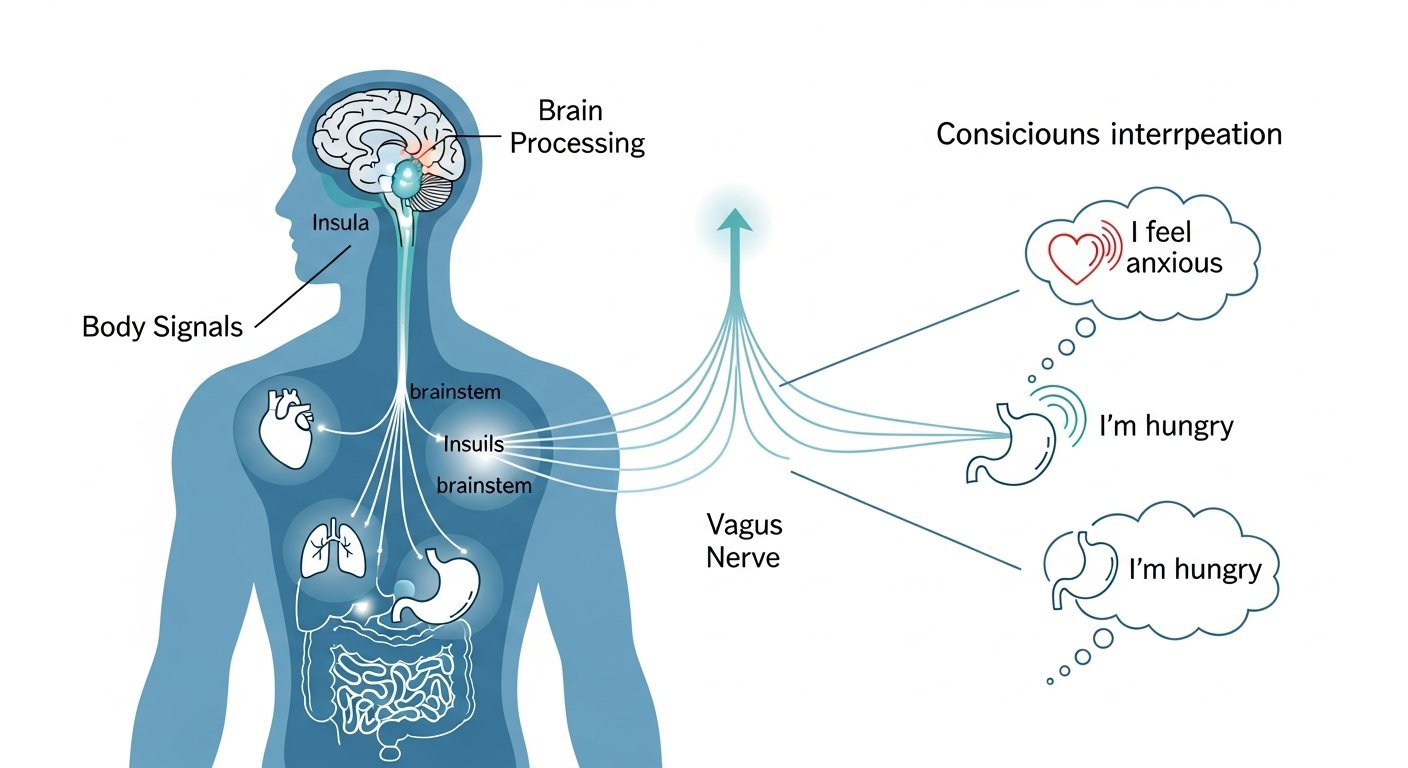
The intricate process of interoception involves a complex interplay between the body's sensory receptors, neural fibres forming brain pathways, and specific regions of the brain. Understanding this neurobiological foundation reveals how our internal sensations are generated, transmitted, and interpreted, forming the basis of our emotional experiences and physiological regulation. This fascinating journey from body cells to brain awareness highlights the sophisticated communication network that keeps us alive and aware of our internal states—down to the mechanistic level of how each neuron/ nerve cell passes information forward.
The Body's Nerve Receptors and Brain Pathways
Sensory receptors located throughout our internal organs and tissues constantly monitor physiological parameters like blood pressure, temperature, stretch, and chemical composition. These specialised nerve receptors include mechanoreceptors (which detect pressure and stretch) and other sensor types that convert changes in the body into electrical activity. These receptors activate sensory neurons, which translate these physical and chemical changes into electrical signals. These signals then travel along neural fibres, forming intricate brain pathways that ascend through the spinal cord and ultimately reach various brain structures, including the thalamus, which acts as a relay station, before arriving at their primary processing center. These sensory systems are the first step in the body's complex dialogue with the brain.
The Insular Cortex: Your Brain's Interoceptive Hub
At the heart of interoception lies the insular cortex, a deep cortical region of the brain—often shortened to the insula. The anterior insular cortex is critically involved in integrating interoceptive information with emotional and cognitive processes. It receives signals from the body and plays a pivotal role in creating our subjective emotional experience of feelings, pain, and body sensations. Neuroimaging techniques, such as Transcranial Magnetic Stimulation (TMS), are helping researchers understand how the insular cortex processes these incoming signals, highlighting its role in higher-level cognitive functions influenced by internal states.
The Vagus Nerve: A Superhighway for Inner Sensations
The vagus nerve, the longest cranial nerve, is a primary conduit for interoceptive information, particularly from the heart and gut. It acts as a bidirectional communication channel, carrying sensory data from internal organs to the brain and transmitting efferent signals from the brain back to the organs. This "superhighway" is crucial for regulating vital functions and plays a significant role in the gut-brain axis, influencing everything from digestion to mood. Understanding and potentially stimulating the vagus nerve is becoming increasingly important for improving emotional regulation and overall well-being.
The Autonomic Nervous System and Internal Organs: A Constant Dialogue
The autonomic nervous system (ANS), comprising the sympathetic (fight-or-flight) and parasympathetic (rest-and-digest) branches, works in constant dialogue with our internal organs. Interoception is intricately linked to the ANS's activity. For instance, the detection of increased heart rate and breathing during a stressful event is an interoceptive signal processed by the brain, which then influences the ANS's response. This continuous loop ensures our body can adapt to changing internal and external conditions, managing essential autonomic functions and providing the body signals we interpret as feelings—while also regulating signals that help return us to baseline.
The Somatosensory Pathway: How Signals Reach Your Brain
The signals from our internal organs travel via the somatosensory pathway, a complex network of nerves that conveys sensory information from the body to the central nervous system. This pathway includes afferent nerve fibers that carry interoceptive information from the viscera to the spinal cord and brainstem, eventually reaching higher brain centers like the insula. The lamina I spinothalamic pathway is a key component of this system, specifically transmitting pain and temperature signals from the body's surface and internal organs to the brain for processing. This sophisticated system ensures that our brain is continuously updated on the state of our internal bodily systems, in coordination with areas like the primary somatosensory cortex (sometimes discussed as including 5.6 somatosensory cortex regions in broader mapping conversations).
Why Your Inner World Matters: The Profound Impact of Interoception on Well-being
The ability to accurately perceive and interpret our body signals is not just about recognizing basic needs; it is fundamental to our emotional well-being, self-awareness, and overall resilience. When our interoceptive system functions optimally, we gain access to a wealth of information that guides our decisions, helps us manage stress, and fosters a deeper understanding of ourselves. This profound mind-body connection is the bedrock of a healthy and fulfilling life, influencing everything from our daily choices to our long-term health outcomes.
Emotional Experience and Regulation: From Gut Feelings to Emotional Intelligence
Our emotional experience is deeply intertwined with interoception. What we perceive as a "gut feeling" is often our brain interpreting subtle internal sensations associated with emotional states. For example, the tightness in your chest might signal anxiety, while a flutter in your stomach could indicate excitement or nervousness. High interoceptive attention allows us to more accurately identify, label, and understand these emotions, which is the cornerstone of emotional regulation. Emerging evidence supports a significant relationship between interoception and emotional regulation in children and youth Pedersen et al., 2023, Frontiers in Psychology, highlighting its foundational importance from a young age.
Self-Regulation and Homeostasis: Maintaining Your Inner Balance
Interoception is crucial for self-regulation, the ability to manage our internal states and behaviors. By sensing signals like hunger, fatigue, or rising stress levels, we can take appropriate actions to restore homeostasis – the body's stable internal environment. For instance, recognizing the physical signs of exhaustion allows us to rest, preventing burnout. This constant internal calibration, guided by internal signals, is essential for maintaining physical and mental equilibrium.
Decision-Making and Intuition: Trusting Your Gut Feeling
Our body signals play a significant role in our decision-making processes, often acting as a form of intuition. When we can accurately interpret these internal sensations, we can make choices that are more aligned with our needs and values—especially in certain decisions that carry emotional weight or uncertainty. This "gut feeling" is your interoceptive system providing feedback based on past experiences and current physiological states. Research indicates that the brain utilizes interoceptive information to make subsequent moral decisions, with differential heartbeat-evoked potentials observed between utilitarian and deontological moral decision-making Gao et al., 2018, Neuropsychologia. This highlights the profound influence of internal states on complex cognitive processes.
Self-Awareness and Personal Identity: Knowing Yourself from the Inside Out
A well-developed interoceptive sense fosters profound self-awareness. By paying attention to our internal sensations, we gain a deeper understanding of our bodily needs, emotional patterns, and overall state of being. This connection to our internal world is fundamental to forming a coherent sense of self and identity. It allows us to understand our reactions, preferences, and limits, leading to a more integrated and authentic self, driven by our internal radar.
Resilience and Trauma: Healing Through Embodiment
For individuals who have experienced trauma, interoception can be both challenging and a pathway to healing. Trauma can disrupt the body's ability to send and receive clear body signals, leading to dissociation or hypervigilance. By gently re-engaging with internal sensations through embodied practices, individuals can begin to process traumatic experiences, reclaim their sense of safety in their bodies, and build resilience. This process of embodiment is key to healing and recovery, helping to re-establish a secure connection to one's inner world.
Interoception Across the Spectrum: Challenges and Neurodivergence
Interoception is not uniformly experienced; its perception and processing can vary significantly among individuals, with notable differences observed in neurodivergent populations and those experiencing mental health challenges. Understanding these variations is crucial for tailored support and interventions, as challenges with interoception system functioning can significantly impact daily life, emotional regulation, and overall well-being.
Interoception in Autism Spectrum Disorder (ASD) and ADHD
Individuals on the autism spectrum disorder (ASD) and those with ADHD often exhibit atypical interoceptive experiences. This can manifest as either hypo-sensitivity (under-responsiveness) or hyper-sensitivity (over-responsiveness) to body signals. For example, an autistic individual might not recognize hunger or thirst until it's extreme, or conversely, might be overwhelmed by the sensation of their own heart rate. It is estimated that a significant portion of autistic individuals experience atypical sensory processing, which often includes challenges with interoception Happé & Ronaldson, 2005, Journal of Autism and Developmental Disorders. This can impact self-care, emotional regulation, and social interactions.
The Link Between Interoceptive Dysregulation and Mental Health
Dysfunctions in interoceptive processing are implicated in a range of psychiatric and neurological disorders, including depression, anxiety, schizophrenia, chronic pain, and neurodegenerative diseases Fuchs & Bohring, 2023, Frontiers in Psychiatry. For instance, individuals with depression may struggle to differentiate between physical discomfort and emotional distress, or may have a dampened sense of internal pleasure. Similarly, the heightened awareness of body sensations in anxiety can lead to a vicious cycle of worry and physical symptoms. Effective interoceptive skills are therefore vital for maintaining mental well-being and fostering effective emotional regulation.
Practical Pathways to Inner Awareness: Enhancing Your Interoceptive Skills
Fortunately, interoception is not a fixed trait; it is a skill that can be cultivated and strengthened through practice. By engaging in specific techniques, individuals can improve their ability to sense, interpret, and respond to their internal signals, interoceptive signals, and other body signals, leading to enhanced self-awareness and well-being. These interoception exercises can range from simple mindfulness practices to more targeted interventions, often incorporated into therapeutic approaches like occupational therapy.
Mindful Body Scans and Check-ins: A Foundation for Awareness
Mindful body scan meditation and regular mindful check-ins are foundational practices for building interoceptive awareness. This involves systematically bringing attention to different parts of the body and noticing any body sensations present without judgment. Whether it's feeling the rise and fall of your chest, the warmth in your hands, or tension in your shoulders, these practices train your brain to register and interpret subtle body signals. A meta-analysis of 29 randomized controlled trials found a small-to-medium positive effect of mindfulness interventions on self-reported interoception measures, indicating that regular meditation practice significantly enhances interoception awareness Mehling et al., 2012, Psychological Science.
Focused Breathing and Breathwork: Harnessing Your Respiratory Rhythm
Breathing is a fundamental physiological process intimately connected to our internal states and emotions. Focused breathing exercises, such as diaphragmatic breathing, can help you become more attuned to the subtle movements of your diaphragm and chest, enhancing awareness of your respiratory rhythm. Mindful breathing exercises and breathwork techniques, ranging from simple deep breathing exercises to more complex practices, can directly influence the autonomic nervous system, promoting regulation and providing immediate feedback on your internal sensations.
Tuning Into Your Heartbeat: Direct Physiological Awareness
Consciously attending to your heart rate is a direct way to engage with interoception. This can be done by placing a hand on your chest and feeling the pulse, or by simply focusing your attention on the sensation of your heart beating within your chest. Observing how your heart rate changes in response to different activities, thoughts, or emotions can provide valuable insights into your body's physiological responses. Practicing heartbeat counting or using a heart monitor can further enhance interoceptive accuracy and heartbeat detection. For those interested, heartbeat detection tests can serve as excellent interoception exercises—and you may see the heartbeat-counting task referenced in research or clinical discussions.
Mindful Movement Practices: Connecting Body and Mind
Practices like yoga, Tai Chi, or even a mindful walk encourage a deeper connection between the mind and body. These activities draw attention to the sensations of movement, balance, and muscle engagement, fostering a greater awareness of how your body feels in action. This integration of touch and internal sensations helps to bridge the gap between physical experience and conscious awareness. Mindful movement is a powerful way to build the mind-body connection and enhance your perception of body sensations.
Journaling Your Internal Landscape: Documenting Your Sensations
Journaling your internal sensations and experiences can be a powerful tool for developing interoceptive skills. By regularly recording the body signals, emotions, and thoughts you experience throughout the day, you can begin to identify patterns, triggers, and the nuances of your inner world. This practice helps to solidify the connection between your physical sensations and your emotional and mental states, increasing self-awareness. Using a zone of regulation chart alongside journaling can also be beneficial for tracking emotional experience.
Therapeutic and Educational Resources for Interoception
For those seeking structured support, various therapeutic and educational resources can be immensely helpful. Occupational therapy plays a significant role, with an Occupational Therapist often employing sensory-based strategies and interoception exercises to improve self-regulation. Prominent figures like Kelly Mahler have developed comprehensive curricula, including The Interoception Curriculum and its Digital Curriculum and Adult Learning Modules, designed to build interoception awareness builders. Frameworks like Zones of Regulation (and resources such as Getting Into The Zones of Regulation) offer practical tools for understanding and managing emotions, often incorporating visual cues and social stories for children. Platforms like Therapy Connect and online therapy sessions can also provide access to professionals skilled in addressing interoceptive challenges. Specialized sensory techniques, such as engaging with temperature activities, floatation environments, or using tools like a stress ball, can also be valuable. For individuals with specific needs, heavy work activities, LED facial treatments, scalp massage, warm compresses, and skincare routines, when approached with a sensory lens, can support general sensory processing and body awareness. If you’re exploring interoception within integrative health, evidence-informed overviews and resources may also be found through nccih, alongside more mainstream sources such as Harvard Medicine magazine; and for individualized guidance, consider working with a clinician who can help you interpret body cues safely.
Conclusion
Interoception is far more than a biological function; it is the foundation of our embodied experience, a constant whisper from our inner selves guiding us toward balance, understanding, and well-being. By recognizing and cultivating this often-overlooked sense, we unlock a profound capacity for self-awareness, emotional intelligence, and resilience. From deciphering the subtle cues of our emotions to making more aligned decisions and navigating the complexities of chronic pain or the challenges faced by individuals with autism spectrum disorder, our interoceptive skills are instrumental in shaping a more integrated and fulfilling life. Whether we are addressing everyday well-being or supporting individuals navigating significant mental or physical health challenges, understanding and enhancing interoception offers a powerful pathway to a more connected and compassionate existence. By embracing our internal radar, we can foster a deeper understanding of ourselves and navigate life with greater ease and insight.
